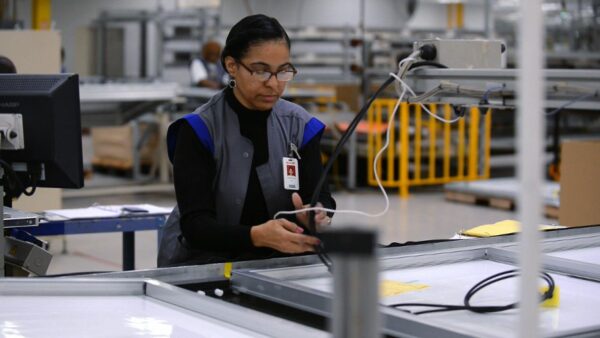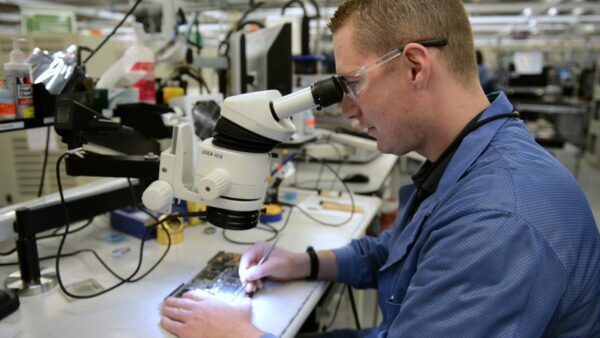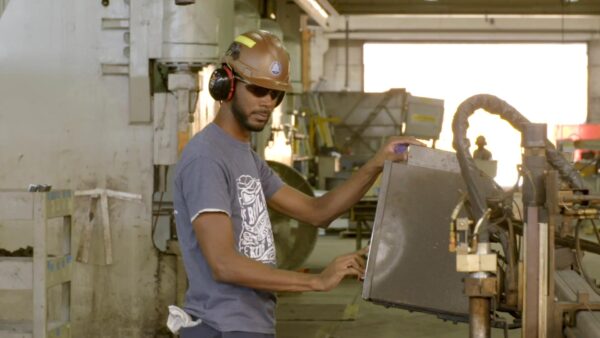
Greg Munday and Gail Nadeau of Waltham, Mass., Local 1505 work on radar for Patriot missile systems in Raytheon’s hardware integration center, which is getting on-the-clock Code of Excellence training.

More than 2,400 Raytheon Technologies missile and defense workers are getting on-the-clock training on the IBEW’s Code of Excellence program , thanks to a years-long effort by the leaders of Waltham, Mass., Local 1505 and representatives from the Second District office .

“This is the biggest Code of Excellence implementation in the Manufacturing branch,” said Director of Manufacturing Brian Lamm, explaining that rank-and-file workers and managers alike will receive code training over the coming year. “The contract ensures 100% participation. It’s huge for us.”

Launched by International President Edwin D. Hill in 2007, the Code of Excellence was designed to ensure the highest standards in every IBEW workplace. Where the code is formally embraced, leaders and members are expected to commit to demonstrating the union’s core values in everything they do: safety, professionalism, accountability, relationships and quality.

“It’s taken us a long time to get here,” Lamm said of efforts to bring the Code of Excellence to this Raytheon facility, where workers manufacture such things as radar systems and their components, missile launch systems, and the unarmed missiles for them. (Explosive ordnance for these is installed later at another location.)

Over those years, representatives from the Second District, whose purview includes Massachusetts, negotiated alongside leaders from Local 1505 to begin implementing the Code of Excellence, with Raytheon finally agreeing to allow classes to begin in 2021.

“Code training was going to be voluntary at first, but then we negotiated to make it mandatory,” said Second District International Representative John Horak, who services Local 1505.

One of the IBEW’s biggest remaining implementation hurdles was convincing Raytheon that it would be worth its while to allow the hourlong Code of Excellence classes to be conducted on company time.

“One hour per employee is not a small expense” when multiplied by 2,400 employees, noted Lamm.

The company recently agreed to budget for code classes to be held as part of an employee’s regular workday, said Local 1505 Business Manager Michael Zagami, and this iteration of Code of Excellence training is now officially underway.

“There are so many departments and a lot of different skill sets,” Zagami said. “It’s going to be a challenge for us, but the company is committed, and we’re willing to do what it takes.” He added that Local 1505 was the first IBEW local to negotiate a contract with Raytheon in the late 1940s.

“We have a commitment from Raytheon to give every employee this training,” Horak stressed. “It’s mandatory for all new employees, too — a condition of their employment.”

Members of the IBEW’s Education Department, led by International Representative Craig Duffy, have been conducting train-the-trainer sessions for a group of 10 to 12 chief stewards and 30 to 40 department stewards, with continuing support provided by the department during this first year. “The local is handpicking the core group of trainers, and we’re doing meetings of 20 or so workers at a time,” Horak said.

Lamm credited Zagami for assembling the team that made it possible. “They even got Raytheon to commit to flying a Code of Excellence flag outside its entrance,” he said.

“The local’s been all-in, too,” Horak added, with Zagami meeting regularly with Raytheon’s labor relations team. “Everyone knows that this is not something we can do a couple of times. There’s no second chance with this.”

Horak said the training agreement also should help other businesses take notice of the IBEW’s commitment to such things as quality, professionalism and safety, helping the union further expand its reputation for being the first choice for the job.

“We’re talking about a company that’s a huge defense contractor. It’s the largest Raytheon office in the Northeast,” Horak said. “We’re helping them see how the Code of Excellence truly fits their culture.”


written contract

In the semiconductor industry, a written contract is the difference between promises and protections. Verbal commitments and company policies can change overnight, but a union contract puts wages, healthcare, retirement, and workplace protections in writing—where they are enforceable. Without a contract, benefits can be reduced, restructured, or taken away at management’s discretion. Through Chips Workers United and the IBEW, workers stand together to negotiate binding agreements that lock in hard-earned benefits, establish clear rules, and provide a real voice on the job. A written contract means stability, accountability, and peace of mind—today and for the future.

IBEW Yes! Logo
A placeholder image with the text "There was an error processing this image" on a gray background.

opportunity to thrive

We take pride in supporting one of the most highly trained workforces in the semiconductor industry and are committed to ensuring workers have meaningful opportunities to grow professionally. Drawing on the IBEW’s proven track record and decades of experience advocating for workers, this effort emphasizes access to opportunity through comprehensive training in advanced manufacturing, cleanroom environments, safety, and evolving technologies. These skills help workers adapt in a rapidly changing industry and build strong, long-term careers with expanded opportunities across the semiconductor sector. With a voice at work and a seat at the table, process changes and industry evolution do not have to mean layoffs. Through collaboration, workers and companies can thrive.

IBEW Yes! Logo
An icon featuring a blue megaphone with sound waves emanating from it, all within a blue circle with a white background.

a voice at work

When workers come together through Chips Workers United, they gain a collective voice at work and meaningful representation on the job. Union representation gives workers a say in wages, benefits, and work rules, and provides important workplace protections, including the right to representation during investigatory meetings and the ability to raise concerns collectively without fear of retaliation. Without a union, decisions about pay, scheduling, and workplace rules are made unilaterally. Collective bargaining ensures workers have a seat at the table and a role in shaping fair, transparent workplace standards

IBEW Yes! Logo

For Families

IBEW Yes! Logo

Unions help workers earn better wages through collective bargaining. That extra income allows families to afford safer housing, healthier food, reliable transportation, and opportunities like college savings or vacations — all of which contribute to a better quality of life at home.

Better Work-Life Balance

Union contracts often include protections for fair scheduling, paid time off, and guaranteed breaks. This gives working parents more time to be present in their families’ lives — whether it’s attending a child’s school play, helping with homework, or just sharing dinner together.

Affordable, Reliable Healthcare

Union-negotiated benefits frequently include comprehensive health coverage for the entire family. That means fewer out-of-pocket medical costs, access to preventive care, and peace of mind knowing children and spouses are protected if health issues arise.

Job Security and Protection from Unfair Treatment

Unions ensure that workers can’t be fired without just cause and have a grievance process if they’re treated unfairly. This job stability helps families plan for the future and shields them from sudden job loss or retaliation, creating a more secure home environment.

Support for Education and Training

The IBEW is committed to providing resources that help families build long-term opportunities, allowing both workers and their children to grow and succeed through education.

Advocacy for Family-Friendly Laws

Unions don’t just negotiate with employers — they also advocate for policies that benefit all working families, like paid family leave, affordable childcare, and public education funding. Their political voice helps shape a society that better supports parents and kids alike.

Higher Wages Mean Greater Financial Stability

Unions foster solidarity and support, not only in the workplace but also in the wider community. From food drives and scholarship funds to helping members in times of crisis, unions create a culture of care that families can rely on in good times and bad.

Rights To Organize

IBEW Yes! Logo

Worker Rights

IBEW Yes! Logo

Forming A Union

IBEW Yes! Logo

For You

Mutual Success and Stability:
Shared Prosperity: A positive and collaborative relationship fosters an environment where the success of the manufacturing company is intertwined with the well-being of its employees. When the company succeeds, it can share the benefits with its workforce through fair compensation, performance bonuses, and other incentives. This creates a sense of shared prosperity, aligning the interests of the employees and the company.

Long-Term Partnership: A stable and cooperative relationship between the company and the union sets the foundation for a long-term partnership. This stability allows both parties to plan for the future with confidence, knowing that they can rely on each other for support and collaboration. Long-term partnerships contribute to the overall sustainability and success of the business.

Adaptability and Resilience: In the face of economic challenges or industry changes, a mutually supportive relationship between the company and the union allows for collective problem-solving and adaptation. Joint efforts in navigating uncertainties can lead to more resilient strategies and solutions that benefit both individual employees and the company as a whole.

Employee Engagement and Commitment: When employees feel that their interests are considered and valued, they are more likely to be engaged and committed to the company’s success. A positive work environment resulting from the collaborative efforts of the company and the union promotes a strong sense of loyalty and dedication among employees, contributing to the overall stability of the workforce.

Open Communication Channels: Mutual success relies on transparent and open communication channels between the company and the union. Regular dialogue allows for the identification of common goals, the resolution of issues, and the continuous improvement of working conditions. Transparent communication builds trust and strengthens the foundation for a relationship based on mutual success and stability.

Competitive Advantage: A manufacturing company that can demonstrate a harmonious and mutually beneficial relationship with its workforce through the union gains a competitive advantage in the market. This positive reputation can attract top talent, enhance customer trust, and appeal to investors who value responsible and collaborative labor practices.

IBEW Yes! Logo

For Manufacturing

Improved Communication:
Open and transparent communication between the company and union fosters trust and understanding. Timely sharing of information reduces misunderstandings, leading to smoother operations and better collaboration.

Enhanced Productivity:
A harmonious relationship encourages a cooperative approach to problem-solving and process improvement. Union workers, when engaged positively, are more likely to contribute to efficiency and productivity gains within the manufacturing processes.

Workforce Stability:
A positive relationship with the union helps in maintaining a stable and motivated workforce. Reduced labor turnover and increased job satisfaction contribute to consistent production levels and lower recruitment costs.

Conflict Resolution:
Effective labor-management collaboration facilitates quicker resolution of disputes and conflicts. Addressing concerns promptly helps maintain a positive work environment, preventing disruptions to production schedules.

Employee Well-being:
A harmonious relationship promotes the well-being of union workers through fair wages, benefits, and working conditions.
This, in turn, enhances employee morale, engagement, and commitment to the company’s success.

Competitive Advantage:
A positive relationship with the union can be a competitive advantage in the marketplace. Demonstrating a commitment to fair labor practices and collaboration with the workforce can enhance the company’s reputation and appeal to customers and investors. A harmonious relationship with union labor, therefore, not only contributes to a positive workplace culture but also brings tangible benefits to the manufacturing company in terms of productivity, stability, and competitiveness.

IBEW Yes! Logo

For Communities

Economic Growth:
Strengthened worker-employer relationships foster a stable and productive workforce. Increased employment opportunities and job security contribute to a more resilient local economy.

Local Prosperity:
Healthy employer-employee partnerships lead to higher wages and improved living standards.
Increased disposable income within the community stimulates local businesses and services.

Social Cohesion:
Positive workplace relationships spill over into the community, promoting a sense of belonging and unity.
Shared values and mutual support create a socially connected and harmonious environment.

Skill Development:
Strong worker-employer collaboration encourages skill development and continuous learning.
A skilled workforce attracts new businesses and industries, further diversifying the local job market.

Innovation and Entrepreneurship:
Supportive employer-employee dynamics encourage innovation and creativity. This atmosphere can lead to the emergence of local entrepreneurs and startups, contributing to community development.

Community Involvement:
Engaged employers and workers are more likely to participate in community initiatives. Volunteerism, community projects, and corporate social responsibility activities strengthen the overall fabric of the community. A strong worker and employer relationship, therefore, has a ripple effect that goes beyond the workplace, positively impacting the community at large.

IBEW Yes! Logo

For Workers

Fair and Competitive Compensation:
The union can negotiate fair wages and benefits for individual employees, ensuring that they receive competitive compensation within the industry.
This fosters job satisfaction and loyalty, contributing to a stable and motivated workforce.

Improved Working Conditions:
The union can advocate for improved working conditions, including safety measures and health benefits.  Better working conditions not only enhance the individual employee’s well-being but also contribute to a healthier and more productive work environment.

Job Security:
Through negotiations and collective bargaining, the union can work to secure job protection measures.
Increased job security provides peace of mind for individual employees and promotes a stable workforce for the company.

Professional Development Opportunities:
Collaborative efforts between the company and the union can lead to the establishment of training and development programs. These programs benefit individual employees by enhancing their skills and employability while supporting the company’s need for a skilled workforce.

Employee Representation:
The union serves as a representative for individual employees, ensuring their voices are heard in decision-making processes. This empowerment contributes to a positive workplace culture and helps the company address employee concerns proactively.

IBEW Yes! Logo
An icon featuring a blue stethoscope and a heart with a heartbeat line inside a blue circle with a white background.

Great Healthcare

Union workers enjoy comprehensive and affordable family healthcare. The IBEW negotiates strong health benefits, so workers can access the care they need  without worrying about the costs.

IBEW Yes! Logo
An icon featuring a blue piggy bank with a dollar bill being inserted into the top, all within a blue circle with a white background.

Retirement Security

Union workers enjoy stronger retirement security than their nonunion counterparts. In fact, nearly 100% of union members have retirement benefits through their job.

IBEW Yes! Logo
A placeholder image with the text "There was an error processing this image" on a gray background.

opportunity to thrive

The IBEW takes pride in being the best-trained  workforce around, and we are committed to ensuring that all our members have the chance to grow professionally. The IBEW offers the most comprehensive training in the entire electrical industry, which means more career opportunities for you.

IBEW Yes! Logo
An icon featuring a blue money bag with a dollar sign on it, all within a blue circle with a white background.

better wages

Union members make more money. On average, union workers make nearly 20% more than nonunion workers according to the Bureau of Labor Statistics. That’s because a union contract gives workers the power to make sure they are paid their fair share.

IBEW Yes! Logo
An icon featuring a blue megaphone with sound waves emanating from it, all within a blue circle with a white background.

a voice at work

When workers come together as one, they gain a voice at work, with a say in wages, benefits, and  work rules. Without a union, everything from your paycheck to scheduling is at the whim of  management. But collective bargaining gives you power.

IBEW Yes! Logo