Many who walk, water and groom race horses are Mexican, Central American migrants
By Rick Karlin,Staff WriterUpdated Aug 22, 2023 6:18 p.m
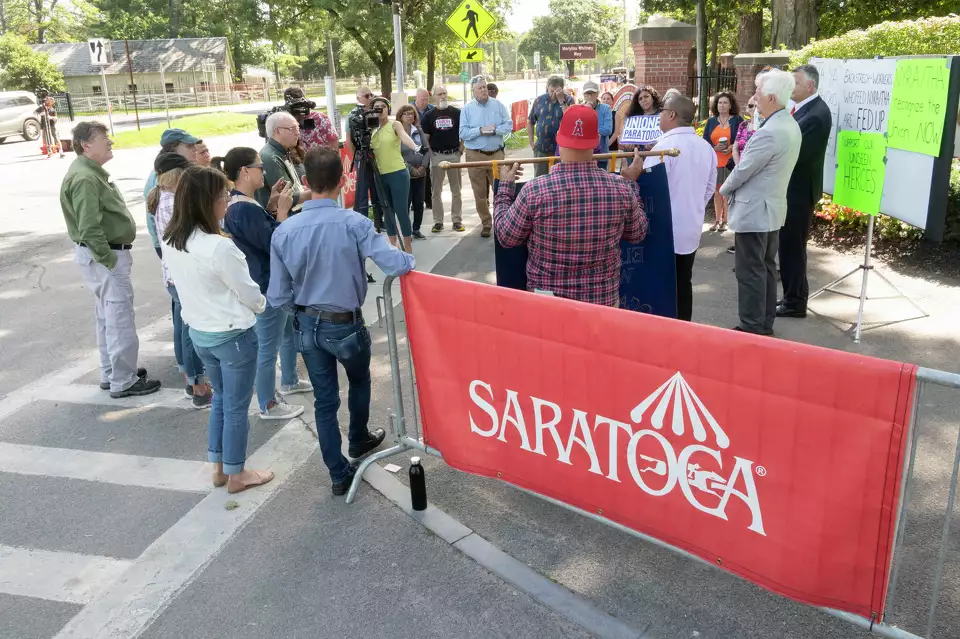
SARATOGA SPRINGS — Noting that they are crucial to New York’s thoroughbred racing industry, organizers with the IBEW Local 1430 union said Tuesday they launched an effort to organize the hundreds of backstretch workers who care for horses at Saratoga Race Course.
“We’ve been doing this for almost four years,” union organizer Gilberto Mendoza said of the effort to get backstretch workers to sign sheets saying they would support being in a union. He has675 signatures so far, he said, and this week Mendoza notified the New York Racing Association as well as the 127 horse trainers who compete at the Saratoga track of their desire for a union.
IBEW,or the International Brotherhood of Electrical Workers, Local 1430 already represents video camera operators employed at the track.
But Mendoza and others admitted that getting union representation with a contract is an uphill battle, due to the way the racing industry is organized and governed in New York.
For instance, NYRA, the organization that puts on thoroughbred meets at Saratoga Race Course as well as the downstate Belmont and Aqueduct tracks, doesn’t directly employ backstretch workers — the horse owners and trainers do.
That means that a union drive entails getting employees of each trainer to organize separately rather than as a whole.
And because horse racing is viewed as an agricultural endeavor, the state Public Employment Relations Office would oversee and ultimately sanction a union drive, Mendoza said.
That’s in contrast to most union drives, which go through the federally run National Labor Relations Board.
Still, supporters of the union drive insisted that backstretch workers, most of whom come from Mexico and Central America and who typically speak no English, are an oft-overlooked group of low-paid laborers without whom the races wouldn’t take place.
“Backstretch workers are the backbone of the race track,” said Diana Barnes, a senior teaching professor of Spanish at Skidmore College who also volunteers as a medical translator for backstretch workers.
“They are carrying the industry,” added Gordon Boyd, a Democratic Party candidate for Saratoga Springs supervisor. “We’ve got a 19th-century business model here that really needs to jump into the 21st century.”
Also supporting the effort was Saratoga Springs Public Safety Commissioner James Montagnino and Terry Diggory from the Saratoga Immigration Coalition.
NYRA spokesman Patrick McKenna said his organization has worked hard to improve conditions for backstretch workers.
“Reflecting our unwavering commitment to the backstretch community in New York, NYRA has recently expanded its ongoing, multiyear campaign to modernize backstretch housing and barn area facilities throughout Saratoga Race Course and Belmont Park,” McKenna said in an email, adding they have invested more than $40 million in recent years to renovate more than 100 residences while constructing new housing.
NYRA will also be breaking ground on the first of three new backstretch dormitories designed to serve the growing population traveling to Saratoga Springs each year.
Horse owners also said they support the backstretch workers, who feed, water, walk and muck out the stalls of their thoroughbreds.
“Uninformed advocates can talk the talk, but NYTHA’s staff and affiliates are out walking the walk every day, providing the sort of support and service that makes a difference in people’s lives,” Joe Appelbaum, president of the NY Thoroughbred Horsemen’s Association, said in an email.
His group represents the more than 100 horse owners and their trainers who are being targeted by the unionization effort.
“We have three nonprofits here,” added Nancy Underwood, president of the Backstretch Employees Service Team, a nonprofit group that provides health and wellness services to backstretch workers.
In addition to health care, other groups provide chaplaincy and child care services, she said. She and others noted that there were no backstretch workers at Tuesday’s announcement.
Mendoza said he didn’t want to bring workers in for fear they could be targeted or fired for expressing pro-union views.
Following the event, the Times Union looked for some workers willing to speak, but found none during a brief trip through the backstretch. There naturally would be few workers around, since Mondays and Tuesdays are “dark,” meaning there is no racing.
Aug 22, 2023|Updated Aug 22, 2023 6:18 p.m.
Staff Writer
Rick Karlin covered the environment and energy development for the Times Union. He previously covered education and state government and wrote about natural resources and state government in Colorado and Maine.