Join the fight for
Managers' Rights
members strong
years of advocating
for workers
A UNION FOR
Click the issues above to learn more!!
Join the IBEW
Elevate your career, secure your future
The International Brotherhood of Electrical Workers proudly represents thousands of government and public service employees across North America. New Jersey State managers perform highly skilled work every day — overseeing operations, supporting employees, and helping deliver the essential services that keep the state moving forward.
Managers are the “backbone” of the State’s workforce and provide both institutional memory from administration to administration; as well as long term continuity of government. Most of our members are career civil service employees who are dedicated to working for the citizens of the State. IBEW Local 30 is dedicated to ensuring that our managers are treated with “fairness, respect and equity.”
IBEW 3rd District
Frequently Asked Questions
Has a Unionized Workforce been harmful to the State of New Jersey?
- First, it’s important to again recognize that managers, just like you and your co-workers formed this union. Using your union to harm the employer would obviously not be in your best interest and is therefore not something you would do.
- Second, the IBEW International and this Local Union specifically are, by no means, anti-employer. We fully recognize that Executives and Managers are co-dependent on each other, and when our State Government does well, it provides opportunities for its workers to prosper too.
- When we formed this union to engage in collective bargaining and we did it to protect our interests and help assure everyone that we are not trampled or scapegoated by our superiors for their mistakes and inabilities.
Why did State Government Manager’s want to form a Union?
There are several reasons workers join or form unions.
- At-Will Employment vs. Working under a Collective Bargaining Agreement (CBA) Absent a contract stating otherwise, many managers were presumed to be at-will employees, and those who were not had no right to representation. Even for managers in the classified service, across many departments, many of the terms and conditions of employment were unilaterally set and changed arbitrarily any time and for whatever reason they wanted. Many time we were left with the choice to “take-it or leave-it.”
- By contrast, workers who form unions and negotiate a contract with their employer are employed under the terms and conditions of that contract. The employer cannot change the terms and conditions of the contract without the union agreeing to those changes, and is legally bound to honor that contract. The contract between a union and an employer is commonly referred to as the Collective Bargaining Agreement or CBA.
Will my department treat me differently if I join a Union?
- This union can’t control how your Department behaves so we can’t promise that it won’t violate the law. However, any threats, coercion, or retaliation by your department will result in the union filing Unfair Labor Practice Charges with the Public Employment Relations Commission (PERC_ and the National Labor Relations Board(NLRB}.
- You can learn more about your rights under the National Labor Relations Act by visiting the NLRB’s website: gov.
- Here are 35 things that employers sometimes do that violate the law. “35 Things The Company Can Not DO Flyer.”
What to Expect from your Department and outside sources.
- Some departments are pro-Union, others are neutral, and still others are anti-Union. Separate from State Government, there are outside entities who are paid well by the Freedom Foundation and the National Right To Work Legal Defense Fund whose it job is to convince you not to join a Union. These well-paid consultants orchestrate and carry out campaigns against public worker unions.
- Upper management will likely talk about Public Worker Unions at captive audience meetings about ow bad Unions and Union Members are.
- The goal of these tactics is to create fear and doubt among those who can be members of a Union.
- They’ll portray the union as a business, saying you’re just customers that the union needs to stay in business. They’ll ask, “Why would want to pay money to a union?
- They’ll try to discourage you by saying that you may end up with less than you have now. (For one, this is an unlawful threat, and two, it’s not true. No contract goes into effect unless it’s voted on and accepted by the workers, and why would you vote to accept a contract that wasn’t beneficial to you?) Click Here for more info on how. “Bargaining does not start from a blank sheet of paper.”
- For more things employers say to dissuade employees from forming unions, click on “12 Dirty Tricks You Should Know About.”
You should be prepared for lies and false statements made by your employer. As such, it is imperative that you do your research and determine for yourself who is telling you the truth and who is lying to you.
How does management feel about a Union?
- Some departments respect their employees’ right to choose to form a union and negotiate collectively.
- Some departments prefer this relationship, as it stabilizes the workforce, helps it retain experienced and valuable workers, and helps them to project their labor costs in the coming years.
- That being said, some departments prefer the “At-Will” employment relationship because it allows them to call all the shots unilaterally. It allows them to make changes anytime it wants or for whatever reason. Having their employees take advantage of the State’s PERC Law creates an unwanted counter to management’s ultimate power. For this reason, some departments will try to convince you that you should not join a union.
What has this union bargained for in our contract?
It’s important to understand that workers don’t hire a union, or bring in a union, they join together with their co-workers to form the union. The reason Local 3o did this is because it’s the only means we had to compel the State of New Jersey to bargain with us in good faith for a written contract. This Local Union along with the experienced representatives of the IBEW have negotiated four agreements. Even with the bargaining committee leading the way, the issues proposed by the union during negotiations are those the workers themselves brought forward. We formed a union to accomplish as a group what none of us could as individuals.
What right do I have as a Unionized Public Worker under the NLRB?
- Can I be fired for being a Member of IBEW Local Union 30? It is clearly unlawful for an employer to retaliate against anyone for joining a Union! Applications and Dues Deduction Cards can be submitted electronically from this website.
- Sometimes an employer will challenge the ability of a title or person to be a part of this bargaining unit. If the State were to challenge your ability to be a part of this Union, we, and our counsel would take this matter up before the New Jersey Public Employee Relations Commission (PRC). PERC listens to the arguments from both sides and makes the final determination of who is included and who is excluded.
What made the State negotiate with us?
- Workers in the United States have a law that gives them the right to join or form unions if they so choose, and it’s unlawful for an employer to threaten, coerce, or retaliate against any employee who chooses to exercise those rights. It’s called the National Labor Relations Act (NLRA), and it was passed in 1935.
- Under the NLRA, employees have a right to engage in concerted activities with co-workers for mutual aid and protection. They can discuss workplace issues with each other such as pay rates, benefits, how they’re being treated by management, etc. Any retaliation by an employer against employees because they’re engaging in this type of activity violates federal law.
- In 2011, a majority of the managers in the Executive Branch of New Jersey’s State Government overwhelmingly voted in a secret ballot election to organize under the IBEW! The NLRB certified the union as the workers’ collective bargaining representative, and since then this local has negotiated four separate agreements enshrining our visions of Fairness of wages, Respect of the work we do, and Equality in our wages!
How much would Union Dues be?
- Our Local Unions dues were voted on by the members of this local union’s and they appear in our By-Laws. Dues to the International Union are voted on by delegates IBEW local unions send to its International Convention held every 5-years. Dues for IBEW local unions are voted on and established by the members of that local and are listed in its By-Laws. The dues for IBEW Local Union 30 have been set at .85% of your annual salary (which is basically $850 for every $100,000.00 in salary). IBEW Local 30 has the lowest dues of any State Employee Union in order to keep more money in the pockets of its members!
What do I do next?
- If you’ve decided that you like the idea of being part of IBEW Local Union 30, you need to convey this to the union! You show that you’re onboard by submitting a Dues Deduction Card. These cards are used by us to let your employer and Centralized Payroll know that you want to be a full member so that we can have you placed on our full member rolls!
- If you’re unsure and want more information, you can contact one of the following IBEW Representatives who can answer your questions. Contact them by phone or email, and your communications will be kept strictly confidential.
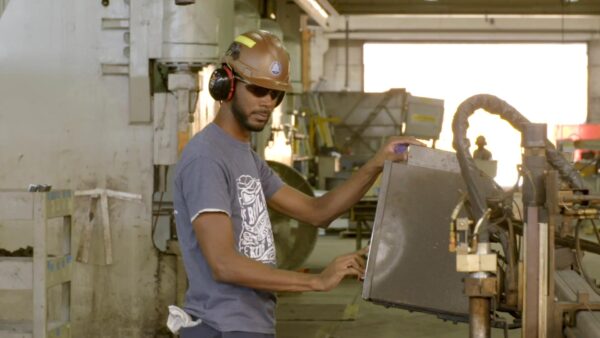
watch our members on the job
:50
:17
3:36
WHO IS THE IBEW? Manufacturing Power Generation Transmission Municipalities Telecommunications Customer Service Utility Workers Electric Cooperatives Nuclear Tree Trimming Broadcasting Railroad Construction Clean Energy Call Centers Gas Workers Maintenance Government Workers
Talk to an Organizer about
improving your workplace
Joe Mastrogiovanni
Delaware, New Jersey, New York, Pennsylvania
Lead Organizer
Phone: (732) 266-1488
Email: [email protected]
Michael McGee
Delaware, New Jersey, New York, Pennsylvania
Regional Organizing Coordinator
Phone: (724) 418-8661
Email: [email protected]
A Workforce Represented By The IBEW Means Having A Voice In Your Healthcare Your Safety Your Hours Your Wages .
Did you know that the IBEW is comprised of workers from a wide array of industries and back grounds? Our Union is unique in that it is a mix of so many industries and workers. Comprising of thousands of workers across the U.S. and Canada that stand together to better their work life. Our diversity brings us the strength and resources to help workers in this multitude of industries.
the facts about unions
Knowledge is Key
Whether you are an experienced veteran or brand new to unions, educating yourself on your rights is key. There are many myths that exist about how a union functions and rights of its members. The interactive chart shares accurate information that will help you in your decision making process.
IBEW story is a simple one. In the days before unionization, managers of our rank did their work, and did it alone. If we did well, our bosses took the credit, and if they did poorly, it was our rank that got the blame. During that blame game, when we stood tall before the man, we stood tall alone. I got involved so that no manager would ever have to go through that alone, ever! Sure, as a Union, we've improved wages but the single most important thing that drives me are rights: both those we've established and those we'll bargain for as we move forward!
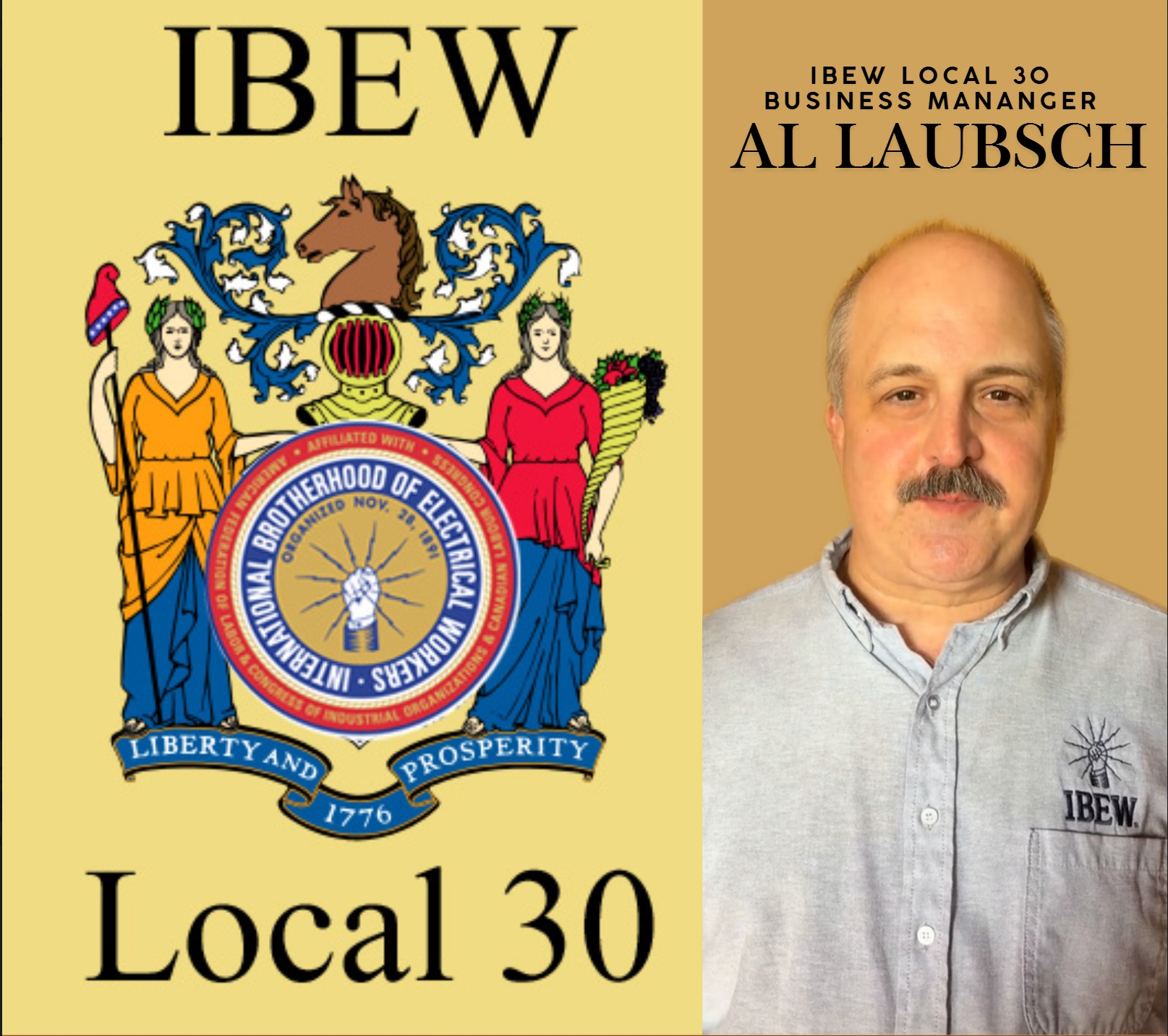
Alfred C. Laubsch, Jr.
Business Manager IBEW Local 30
My career in State Government began in a Psychiatric Hospital and Developmental Center, where I found my passion advocating for some of our state's most vulnerable individuals. As a union member, I advanced through the ranks until I accepted a management position, despite managers having no representation and little opportunity for salary growth.
The decision came with challenges. I supervised employees who earned more than I did, worked a second job to make ends meet, and often felt undervalued. At one point, I seriously considered returning to a union-represented position simply to regain financial stability and professional respect.
Everything changed in 2014 when IBEW Local 30 was established. Through collective representation, managers gained improved wages, benefits, and workplace protections. More importantly, we gained a voice and the respect we deserved.
Since then, I have proudly served Local 30 as an Executive Board member, Contract Bargaining Team member, Shop Steward, and founder of the Women's Committee. I am grateful for the opportunities IBEW has provided and remain committed to advancing the mission of Local 30 and improving the lives of our members and their families.
Nancy Hopkins, MAS
Manager, DMHAS Substance Use Disorder Fee for Service Unit
For years, decisions that directly affected my life were made without my participation —decisions about workplace protections, wage increases, healthcare benefits and other important matters. I was watching from the sidelines, living with decision I didn’t help make, didn’t agree with or sometimes didn’t understand. After attending a union recruitment event at my office, I realized I needed to be at the table where those conversations and decisions were happening.
Joining the union gave me that seat and a voice. Now I’m part of the conversation, helping to shape the decisions that matter. As a shop steward and founding member of the women's committee, I use my voice to make a difference. I connect members with information and support on workplace issues. I advocate for managers—especially women—to have the resources and solidarity they need to succeed.

My union experience has been about more than just having a voice. It’s been about educating myself, empowering others, and engaging in the work that shapes our future—together.
Tamika Young
LSW Supervising Administrative Analyst NJ Department of Children and Families
When I was appointed to become a manager, there was no Union representation, we were at the mercy of the Governor for any Cost of Living Adjustments (COLA). Many employees with lower titles and less responsibilities earned the same salaries and even sometimes more than Managers. Since IBEW's fight for fair wages and compensation, I can honestly say that we have the best representation of any Union in State government, they are, or have been, Managers in government and they understand what we have been through and deal with on a daily basis.

Walter Beland
Bureau Chief | Legal, Regulatory, and Enforcement Policy NJ Department of Environmental Protection